

April 14, 2022 – Determined Ontarians won’t let a chilly spring evening keep them confined to indoor socializing. On the contrary, a mug of hot cocoa on a moonlit patio could very well set the scene for a romantic first date on a brisk spring night.
As families and friends flock to backyard and restaurant patios to celebrate the arrival of spring, Technical Standards and Safety Authority (TSSA) is teaming up with the Ontario Association of Fire Chiefs (OAFC), Ontario Municipal Fire Prevention Officers Association (OMFPOA), Canadian Propane Association (CPA), and Ontario Restaurant Hotel & Motel Association (ORHMA) to raise awareness of patio heater safety practices. Knowing how to use patio heaters and open-flame appliances properly helps keep outdoor gatherers safe from the dangers of fire and carbon monoxide (CO) poisoning.
Know the risks
The risks of fire and CO poisoning aren’t limited to indoor areas. CO is produced by all devices that burn fuel, like patio heaters, and deadly CO gas can accumulate in any environment with limited air movement.
It is important to ensure that areas where patio heaters are located are well ventilated and verify that smoke and CO alarms located inside nearby shelters and buildings are working properly.
Patio heaters, both portable and fixed, and open-flame units are designed for outdoor use only in open areas away from combustible materials. If used inside a tent or other enclosure or near flammable tablecloths or paper products, outdoor heating devices pose serious safety risks.
Fixed fuel-fired appliances, including fire pits, fireplaces and tabletop units, present additional fire hazards caused by open flames. These units must be installed by a TSSA-certified technician.
Heating device safety rules of thumb
When using patio heaters to make outdoor gatherings more enjoyable, keep these safety rules of top of mind.
- Ensure outdoor heaters are positioned on a stable surface so they won’t get knocked over.
- Never leave patio heaters unattended.
- Pay particular attention when children or intoxicated individuals are in the vicinity.
- Keep fire extinguishers easily accessible.
- Never move a portable heater while the flame is lit and make sure the fuel supply is properly shut off and the unit is cool before relocating.
Safety responsibility
It is important to note that this equipment should not simply be pulled out of storage and turned on each year, without being properly inspected and maintained as per the manufacturer’s instructions. Ultimately, owners and operators of outdoor patios and dining areas are responsible for the safe installation, operation, and maintenance of their patio heating units. They must abide by all safety and maintenance instructions outlined in the operating manual for their heating appliances and ensure they understand how to safely operate the heating units and properly handle propane cylinders.
Informational resources on the safe use of outdoor heating devices and propane cylinders, including Patio Heater Safety Guidelines and a Patio Heater Safety Checklist for Restaurant Owners and Operators, are available for download at www.tssa.org.
Quotes
“While fire has associated telltale warning signs, CO is known as The Silent Killer because it is undetectable by smell, sight and taste. In fact, CO is a leading cause of accidental poisonings in Ontario. As such, it is of the utmost importance the patio heaters are situated in well ventilated areas, and CO alarms are installed close by and in good functioning condition.”
Sam Sadeghi
Director, Fuels Safety, Technical Standards and Safety Authority
“Outdoor heating equipment is a great way to enjoy the fresh air – just make sure it’s air you’re breathing and not carbon monoxide from the fuel-burning appliance. All fuel-burning appliances produce a colourless, odorless, tasteless gas called carbon monoxide, which can be deadly to living creatures. When using heating equipment, make sure you follow all of the manufacturer’s directions and only use them in properly ventilated locations.”
Deputy Chief Rob Grimwood
President, Ontario Association of Fire Chiefs
“Outdoor heating devices are great tools that provide temporary warmth when used according to the manufacturer’s instructions. Improperly used devices can lead to the risk of fire and carbon monoxide poisoning. When using these devices, ensure that they are kept away from combustible materials and used in well-ventilated areas.”
Vince Giovannini
President, Ontario Municipal Fire Prevention Officers Association
“Propane is a safe, affordable and green energy source – perfect for the patio! Knowing how to use patio heaters and open flame appliances safely will help everyone enjoy outdoor gatherings all season long!”
Robert Loenhart
Sr. Vice-President of Regulatory Affairs and Safety, Canadian Propane Association
“It is exciting to see Ontario’s many restaurant outdoor patios start opening, creating vibrancy across the many communities. It is vital to follow the proper maintenance and operating standards of patio heaters to ensure these operate safely and are placed in the appropriate locations. Safety supports great patio experiences for all to enjoy.”
Tony Elenis
President & CEO, Ontario Restaurant Hotel & Motel Association
About the Technical Standards and Safety Authority
Throughout Ontario, TSSA enforces provincial safety regulations and enhances public safety. TSSA regulates the safety of amusement devices, boilers and pressure vessels, elevating devices, fuels, operating engineers, and ski lifts. Its range of safety services includes public education, certification, licensing and registration, engineering design review, inspections, investigations, safety management consultation, compliance support, enforcement and prosecution activities. For more information, visit www.tssa.org.
About the Ontario Association of Fire Chiefs
The OAFC represents more than 700 chief fire officers in Ontario, from across 441 municipalities, who are responsible for the management and delivery of fire, rescue, and emergency response to the province’s 14.5 million residents. Its mission is to lead innovation and excellence in public and life safety by inspiring and influencing a safer Ontario. For more information, visit www.oafc.on.ca.
About the Ontario Municipal Fire Prevention Officers Association
The OMFPOA is an independent, non-profit organization representing approximately 200 fire departments across Ontario. For more information, visit www.omfpoa.com.
About the Canadian Propane Association
The CPA represents over 400 companies in every region of the country and promotes a culture of safe propane handling and use of propane-fueled equipment. For more information, visit www.propane.ca.
About the Ontario Restaurant Hotel & Motel Association
The Ontario Restaurant Hotel & Motel Association is the largest provincial hospitality association in Canada. With over 4,000 members, representing more than 11,000 establishments across the province, the ORHMA is dedicated to fostering a positive business climate for Ontario's hospitality industry. For more information, visit www.orhma.com.
-30-
For more information, please contact:
Alexandra Campbell
Vice President, Communications and Stakeholder Relations
Technical Standards and Safety Authority
Telephone: 416-734-6227 | Email: media@tssa.org
Mark Tishman
Program and Policy Analyst
Ontario Association of Fire Chiefs
Telephone: 905-426-9865 x1228 | Email: Mark.Tishman@oafc.on.ca
Vince Giovannini
President
Ontario Municipal Fire Prevention Officers Association
Telephone: 905- 227-6412 | Email: Vince.Giovannini@thorold.ca
Tammy Hirsch
Senior Director, Communications and Marketing
Canadian Propane Association
Telephone: 587-777-3917 | Email: TammyHirsch@propane.ca
Fatima Finnegan
Director of Corporate Marketing & Business Development
Ontario Restaurant Hotel & Motel Association
Telephone: 905-361-0268 | Email: ffinnegan@orhma.com
Toronto, ON, April 6, 2022 – Spring’s much anticipated milder temperatures tend to arrive with rapid snowmelts and heavy rainfalls, which increase the risk of flooding. Technical Standards and Safety Authority (TSSA) reminds Ontarians to be aware of potential fuels and elevator related hazards that can occur during flooding conditions.
Carbon Monoxide and Fuels Safety
When flooding occurs, key energy infrastructures can become temporarily out of commission, tempting residents to turn to alternatives that may be unsafe. Keep in mind that portable, fuel-fired generators, propane BBQs and other outdoor fuel-burning appliances are never safe to use indoors because they can cause carbon monoxide (CO) poisoning and other harmful risks.
“It’s important that residents ensure generators used outdoors are positioned away from open windows, doors and vents,” said Sam Sadeghi, Statutory Director, Fuels Safety Program. “For an added layer of protection, residents should consider using battery-powered CO detectors in areas where generators are operating.”
Elevator Safety
It is also imperative to refrain from elevator use in a flooded building or where there is any indication that water has leaked onto elevator components.
“Water can accumulate in elevator shafts or adversely affect an elevator’s operation, leading to entrapment or injury,” said Roger Neate, Statutory Director, Elevating and Amusement Devices Safety Program. “For this reason, we want to make sure Ontarians are aware that using an elevator during a flood is a safety hazard.”
Visit TSSA.org/Seasonal-Flooding-Safety for TSSA’s full seasonal flooding safety guide. Residents and businesses unsure of how flooding conditions may affect the safeness of specific TSSA-regulated devices should contact TSSA.
About TSSA
Throughout Ontario, the Technical Standards and Safety Authority (TSSA) enforces provincial safety regulations and enhances public safety. TSSA regulates the safety of amusement devices, boilers and pressure vessels, elevating devices, fuels, operating engineers, and ski lifts. Its range of safety services include public education, certification, licensing and registration, engineering design review, inspections, investigations, safety management consultation, compliance support, enforcement, and prosecution activities.
-30-
For more information, please contact:
Alexandra Campbell
Vice President, Communications and Stakeholder Relations
Technical Standards and Safety Authority
Telephone: 416-734-6227
Email: media@tssa.org
For more information on the Technical Standards and Safety Authority, please visit www.tssa.org.
Enbridge Gas & TSSA Caution Homeowners to Keep Gas Meters & Fuel-Burning Appliance Vents Free from Snow & Ice
(January 18, 2022) – With inclement winter weather conditions looming across the province this week, Enbridge Gas and the Technical Standards and Safety Authority (TSSA) strongly advise Ontario homeowners to check their gas meters and the external exhaust outlets for furnaces, fireplaces, water heaters and all fuel-burning devices as soon as possible to ensure no snow or ice has built up. A forecast of rain for tomorrow makes this important safety task time sensitive, as rain has the potential to cause further freezing of accumulated precipitation buildup on gas meters and venting pipes.
“Clearing snow and ice away from the gas meter and the external exhaust outlets for your natural gas burning equipment helps ensure that both the meter and your appliances function safely,” said Bike Balkanci, Regional Director for GTA West and Niagara, Enbridge Gas. “It also allows us to access the meter in the case of an emergency.”
A gas meter covered in snow or ice can impede its function of controlling the pressure of the gas supplied to a home, which could lead to serious risks. In addition, blocked external exhaust vents can cause the carbon monoxide (CO) emitted by fuel-burning appliances to build up in a home, which is also a significant safety hazard.
“Exhaust vents, in particular, often extend out of the side of a home as low as one foot above ground, so they have the potential to get covered and blocked fairly easily without a homeowner’s knowledge, especially when a homeowner is shoveling snow or using a snowblower or when there is a severe snow fall, like the storm we encountered earlier this week,” said Sam Sadeghi, Director, Fuels Safety, Technical Standards and Safety Authority. “We have seen CO poisoning incidents from snow-blocked vents in the past, and these incidents can be fatal, so it’s essential that homeowners are vigilant about keeping their exhaust vents clear.”
Upon noticing a gas meter or external appliance vent pipe is covered with snow, please remove the snow carefully with a car brush or broom. Do not scrape the meter or vent pipe with a sharp instrument, as this may cause unintended damage.
Enbridge Gas reminds Ontarians of these additional safety precautions:
- Do not shovel, plow or blow snow up against the meter or vent pipe.
- Be careful not to bump your meter with a snow blower.
- Never kick your gas meter or vent pipes in an attempt to clear ice and snow.
- Remove any icicles from overhead eaves troughs to ensure dripping water does not splash and freeze on the meter or vent pipe.
Visit the Enbridge Gas website for more information on keeping gas meters clear.
“We also encourage homeowners to install and test certified CO alarms, which will warn them of rising CO levels in their homes and give them and their families time to take potentially life-saving action,” said Sadeghi. “It is also important for homeowners to be able to recognize the symptoms of CO poisoning, which can occur once a fuel-burning appliance exhaust vent has been blocked.”
To report a meter icing problem or for any other natural gas emergency, call 1-866-763-5427.
About the Technical Standards and Safety Authority
Throughout Ontario, TSSA enforces provincial safety regulations and enhances public safety. TSSA regulates the safety of amusement devices, boilers and pressure vessels, elevating devices, fuels, operating engineers, and ski lifts. Its range of safety services includes public education, certification, licensing and registration, engineering design review, inspections, investigations, safety management consultation, compliance support, enforcement and prosecution activities. For more information, visit www.tssa.org.
About Enbridge Gas
Enbridge Gas is Canada's largest natural gas storage, transmission and distribution company based in Ontario, with over 170 years of service to customers. The distribution business provides safe, affordable, reliable energy to about 3.8 million customers and is leading the transition to a clean energy future through net-zero emissions targets and investments in innovative low-carbon energy solutions. The storage and transmission business offers a variety of storage and transportation services to customers at the Dawn Hub, the largest integrated underground storage facility in Canada and one of the largest in North America. Enbridge Gas is owned by Enbridge (ENB), a Canadian-based leader in energy transportation and distribution. Learn more at www.enbridgegas.com.
-30-
For more information, please contact:
Alexandra Campbell
Vice President, Communications and Stakeholder Relations
Technical Standards and Safety Authority
Telephone: 416-734-6227 | Email: media@tssa.org
Andrea Stass
Manager, External Communications and Media Relations
Enbridge Gas
Telephone: 519-436-5490 | Email: enbridgegasmedia@enbridgegas.com

Springtime tips for the safe use of patio heaters
FOR IMMEDIATE RELEASE (March 25, 2021) – After hibernating all winter, Ontarians will soon be flocking together with friends and family on restaurant or backyard patios – masked, socially distanced and following regional public health guidelines, of course – to celebrate the arrival of spring.
Since the weather will still be cool for some time, people will be firing up patio heaters to stay cozy and warm while they socialize outdoors. With that in mind, the Technical Standards & Safety Authority (TSSA) in partnership with the Ontario Association of Fire Chiefs (OAFC), the Ontario Municipal Fire Prevention Officers Association (OMFPOA) and the Canadian Propane Association offer the following springtime tips for the safe operation of patio heaters.
Additional information for the safe use of patio heaters and propane cylinders on commercial or backyard patios can be found in TSSA’s TSSA’s Patio Heater Safety Guidelines and TSSA’s Patio Heater Safety Checklist for Restaurant Owners and Operators available at www.tssa.org.
Tips for the Safe Use of Patio Heaters
- Avoid the dangers of fire and carbon monoxide poisoning - Never use patio heaters indoors or in an enclosed area. If patio heaters are used in a shelter, be sure to follow the manufacturers’ instructions for required clearance from combustible materials including shelter walls and overhead covers. To provide adequate ventilation to avoid the hazard of carbon monoxide poisoning, the shelter must either[1]
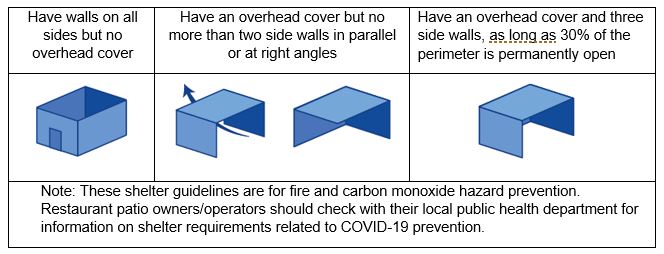
- *[1] As per ANSI Z83.26/CSA 2.37
- Recognize the symptoms of carbon monoxide poisoning - Teach staff and family members to recognize the symptoms of carbon monoxide poisoning (nausea, dizziness, headache).
- Avoid fire hazards – Be sure to adhere to the manufacturers’ instructions for required clearances from combustible materials such as umbrellas, awnings, walls, tablecloths, paper products, decorations, etc. Don’t forget to locate easily accessible fire extinguishers in the patio area.
- Position with care – Always place patio heaters on a stable surface. Make sure patio heaters do not obstruct doors, fire exits or firefighting equipment and are properly distanced from building air intakes.
- Operate safely - Ensure anyone operating a patio heater understands how to disconnect and install propane cylinders, including how to check for leaks. See TSSA’s Patio Heater Safety Guidelines for instructions.
- Keep an eye on them - Never leave patio heaters unattended and pay particular attention when children or intoxicated adults are in the vicinity.
- Store propane cylinders safely – Never store propane cylinders indoors, in a garage, close to operational heaters or near smoking areas. Propane cylinders must be stored upright, outdoors, in an area protected against tampering, unauthorized movement, dropping or vehicle impact that could result in a leak or a fire.
- Use care when transporting propane cylinders – Up to five 20-pound propane cylinders may be transported in a vehicle provided they are safely secured in an upright position in the passenger compartment with the windows open, secured in a trunk with the trunk lid propped open for ventilation, or secured in the ventilated box of a truck. Transportation of more than five 20-pound propane cylinders must be conducted according to Transport Canada Transportation of Dangerous Goods regulations.
Quotes
“It is important for anyone using patio heaters or open-flame, fuel-fired appliances to know how to operate them safety to avoid the dangers of carbon monoxide poisoning and fire. To ensure public safety, all fuel-fired heating units that serve the public must be installed by a TSSA-certified technician in accordance with the manufacturer’s instruction manual.”
Sam Sadeghi
Director, Fuels Safety, Technical Standards and Safety Authority
“Everyone enjoys spending time outside, and supporting local businesses, especially during these unprecedented times. As we start to see more sunshine and warmer days, springtime weather can still be unpredictable, which is why it is important to put safety first. Fuel burning appliances produce carbon monoxide which is the leading cause of fatal poisonings in North America. They must be installed and maintained correctly.”
Fire Chief Mark MacDonald
President, Ontario Association of Fire Chiefs
“You should never trade comfort or expediency for safety when it comes to outdoor heating devices. It is the responsibility of owners and operators of commercial patios and dining areas to ensure that any outdoor heating device is properly installed, maintained, and ventilated according to the manufacturer’s instructions.”
Fire Chief Cynthia Ross Tustin
Director, Ontario Association of Fire Chiefs (OAFC) and member of the OAFC Fire Prevention and Public Education Committee
“It’s been a long, cold winter. As the weather warms up, if you will be operating a patio heater, please follow TSSA’s Patio Heater Safety Guidelines and stay safe.”
Gwen Lewis
President, Ontario Municipal Fire Prevention Officers Association
“As Canadians start getting out and enjoying the weather again, propane patio heaters are a safe, low-emission and effective way to heat any space. For portable propane heaters, always follow the manufacturers’ instructions to ensure safe set up and use outdoors.”
Nathalie St-Pierre
President and CEO, Canadian Propane Association
______________________________________________________
About TSSA
Throughout Ontario, the Technical Standards and Safety Authority (TSSA) enforces provincial safety regulations and enhances public safety. TSSA regulates the safety of amusement devices, boilers and pressure vessels, elevating devices, fuels, operating engineers, and ski lifts. Its range of safety services includes public education, certification, licensing and registration, engineering design review, inspections, investigations, safety management consultation, compliance support, enforcement and prosecution activities. For more information, visit www.tssa.org.
About the Ontario Association of Fire Chiefs (OAFC):
The OAFC represents more than 700 chief fire officers in Ontario, from across 441 municipalities, who are responsible for the management and delivery of fire, rescue and emergency response to the province’s 14.5 million residents. Our mission is to lead innovation and excellence in public and life safety by inspiring and influencing a safer Ontario. For more information, visit www.oafc.on.ca.
About the Ontario Municipal Fire Prevention Officers Association
The Ontario Municipal Fire Prevention Officers Association (OMFPOA) is an independent, non-profit organization representing approximately 200 fire departments across Ontario. For more information, visit: www.omfpoa.com.
About the Canadian Propane Association (CPA)
The Canadian Propane Association (CPA) represents over 400 companies in every region of the country and promotes a culture of safe propane handling and use of propane-fueled equipment. For more information, visit www.propane.ca.
-30-
For more information, please contact:
Alexandra Campbell
Vice President, Communications and Stakeholder Relations
Technical Standards and Safety Authority
Telephone: 416-734-6227 | Email: media@tssa.org
Michelle O’Hara
Executive Director
Ontario Association of Fire Chiefs
Telephone: 905-441-7766 | Email: Michelle.Ohara@oafc.on.ca
Gwen Lewis
President
Ontario Municipal Fire Prevention Officers Association
Telephone: 613-913-4287 | Email: Gwen.Lewis@ottawa.ca
Tammy Hirsch
Senior Director, Communications and Marketing
Canadian Propane Association
Telephone: 587-777-3917 | Email: Tammy.Hirsch@propane.ca
Attachments
FOR IMMEDIATE RELEASE (TORONTO, ON, March 16, 2021) – As the snow melts away and warmer temperatures are in the midst, our spring to-do lists are starting to grow. The Technical Standards and Safety Authority (TSSA) wants to remind Ontario residents that no spring to-do list is complete without one that addresses Carbon Monoxide (CO) safety.
With over 65% of all CO injuries and deaths in Ontario occurring in homes and the average dwelling having roughly 4-6 fuel-burning appliances that produce CO, public education is key when it comes to mitigating these risks.
With the hope that multiple voices will bring greater impact to the message, TSSA partners with other safety-minded organizations to deliver critical information to residents in communities across Ontario. Most recently, TSSA has joined up with the Hawkins-Gignac Foundation for CO Education and a number of eastern Ontario fire and emergency services departments to provide residents with important CO safety messages.
“Although spring is on the horizon, the risks of CO exposure don’t change,” says Sam Sadeghi, Director of TSSA’s Fuels Safety Program. “We need to remember that CO sources can exist in places other than just our homes, such as in our cottages, campers, boat cabins and RVs. CO can build up in these enclosed spaces quickly, and result in harmful and, unfortunately, at-times deadly poisoning.”
Take Action, Think Safe:
- Have all fuel-burning appliances inspected annually by a certified fuel technician.
- To find a TSSA-registered contractor near you use the Find A Registered Contractor Tool at cosafety.ca.
- Install certified CO alarms in your home, regularly test them and replace in accordance with manufacturer’s instruction.
“Safety is a shared responsibility” adds Sadeghi, and by taking these actions we can lower CO risks in our homes.”
Lastly, know the symptoms of CO poisoning. They are similar to the flu – nausea, headache, burning eyes, confusion and drowsiness – except there is no fever. If these symptoms appear, it is imperative to get everyone outside to fresh air immediately and call 911 or the local fire department.
For more valuable safety information, visit TSSA’s public safety website – www.safetyinfo.ca.
Additional Resources:
Trunk Slammers Campaign (Fraudulent Fuels Safety Workers):
- TSSA Fraud Prevention Month Warning Media Release - March 1, 2021: TSSA Kicks Off Fraud Prevention Month with a Warning to Ontarians to be Aware of Fraudulent Fuels Workers
Patio Heater Safety:
About TSSA
The Technical Standards and Safety Authority (TSSA) is one of Ontario’s public safety regulators mandated by the Government of Ontario to enforce provincial safety regulations and enhance public safety. Throughout Ontario, TSSA regulates the safety of amusement devices, boilers and pressure vessels, elevating devices, fuels, operating engineers, and ski lifts. Its range of safety services include public education and consumer information, certification, licensing and registration, engineering design review, inspections, investigations, safety management consultation, compliance support and enforcement and prosecution activities. The organization’s vision is to be a valued advocate and recognized authority in public safety.
-30-
For more information, please contact:
Alexandra Campbell
Vice President, Communications and Stakeholder Relations
Technical Standards and Safety Authority
Telephone: 416-734-6227
email:media@tssa.org
For more information on the Technical Standards and Safety Authority, please visit www.tssa.org.