
With winter upon us, what could be cozier than basking in the warmth of fireplaces, furnaces and outdoor heaters? Yet, it is vital to ensure that your home heating appliances and systems are operating at their best. Failure to do so could expose you and your loved ones to the ‘Silent Killer’—Carbon Monoxide (CO)—often without awareness.
While CO presents serious hazards, you can protect yourself and your family from harm by following these guidelines throughout the cold winter months.
Demystify the ‘Silent Killer’
CO is an invisible, odourless, and tasteless poisonous gas that can pose a deadly risk if not managed properly. Common household fuel-burning appliances like furnaces, fireplaces, gas stoves, propane heaters, kerosene lanterns, can be sources of CO. Approximately 65% of all CO injuries and deaths in Ontario occur in people’s homes. Remember, it’s not just your furnace or fireplace; many Ontario homes can have between 4-6 fuel-burning appliances that produce CO.
Address the Hazard at the Source
Schedule regular inspections for your home's fuel-burning appliances and equipment through the services of a TSSA-registered fuels contractor, which can be conveniently located using TSSA’s lookup tool.
Equip Your Home with Functioning, Certified CO Alarms
Install certified CO alarms, test them regularly and replace them as needed and in accordance with manufacturer’s instructions. These alarms serve as an early warning system that provides time to take life-saving measures.
Recognize CO Poisoning Symptoms
Familiarize yourself with the symptoms of CO poisoning, which can mimic the flu – but without the fever. If symptoms like nausea, headache, burning eyes, confusion, or drowsiness appear, evacuate everyone, including pets, to fresh air and call 911.
Never Operate Indoors Any Fuel-Burning Appliance Designed for Outdoor Use
Do not use indoors any fuel-burning appliances that are designed for outdoor use only, such as propane or kerosene-fueled heaters, bbqs, etc., as this can lead to lethal CO exposure, fires, and other health hazards.
Quick Tips for Maintaining Home Heating Systems
Whether you prefer a hands-on approach or opt for professional assistance in maintaining your home heating system, here are some quick tips for you:
Do it Yourself:
- Regularly inspect the heating system for signs of deterioration, such as water stains, corrosion, or leakage.
- Routinely clean furnace air filters in forced-air systems. Maintain a clear zone around the furnace area to prevent materials from catching fire or exploding due to excessive heat.
- Ensure that warm-air outlets and cold-air outlets are unobstructed. In case snow or ice covers your outdoor gas meter or external appliance vent pipe, remove it carefully with a car brush or broom.
- Don’t scrape the meter or vent pipe with a sharp instrument, as this may cause unintended damage.
Seek Professional Support:
- If the heating system malfunctions, check the electrical fuse, switch, and thermostat before contacting a TSSA-registered fuels contractor.
- Never allow uncertified gas technicians and unregistered contractors to tamper with or conduct work on heating systems.
For additional safety information and resources, visit cosafety.ca. Here's to a secure and warm winter season.
TSSA Reports Significant Decline in Permanent Injuries for 2023
2023 Public Safety Report Now Available at TSSA.org
Toronto, ON, September 22, 2023 – In its 2023 Annual Public Safety Report, the Technical Standards and Safety Authority (TSSA) reported a significant reduction in permanent injuries within its regulated sectors for the 2023 fiscal year. The report, released during TSSA’s Annual Public Meeting alongside its 2023 Annual Report, revealed a consistently stable safety environment in Ontario.
“Our data shows the state of safety in the province seems to be improving,” said Viola Dessanti, Director of Strategic Analytics, TSSA. “While the results of the previous two years were impacted by COVID-related closures, this year’s number of permanent injuries shows a significant decrease, when compared to the five-year pre-pandemic average. We hope this is a continuing trend.”
State of Safety Snapshot
As Ontario’s public safety regulator, TSSA enforces technical safety regulations that govern the amusement devices, boilers, pressure vessels, elevating devices, fuels, operating engineers, and ski lifts sectors. TSSA's Public Safety Report presents complete and comprehensive metrics and results that inform its regulatory approach to enhancing public safety in the province.
During the reporting period (May 1, 2022, to April 30, 2023, TSSA’s 2023 fiscal year, which will be referred to as 2023 hereinafter), permanent injuries dropped by more than 30 per cent compared to the 10-year average.
TSSA categorizes potential issues found during inspections as either high-risk orders or safety tasks. Over the past five years (2019-2023), 90 per cent of periodic inspections found no high-risk issues, while 27.5 per cent of periodic inspections found no issues at all.
Enhancing Safety as an Outcome-Based Regulator
“TSSA has launched a number of outcome-based regulatory initiatives over the past three years that have improved safety in the province,” said Bonnie Rose, President and CEO, TSSA. “Compliance Standards are one of these efforts, which we have now expanded to cover more devices and integrated within our IT business solution. Doing so equips us with additional data insights to strengthen our regulatory oversight.”
TSSA introduced new Compliance Standards for passenger elevators (hydraulic and traction), ski lifts, and escalators in 2023. The compliance standards are designed to direct owners, contractors, mechanics and inspectors of these devices towards non-compliances that are highly correlated with risk and demand immediate mitigation by the regulated parties.
An active authorization such as a device licence or contractor registration is necessary for TSSA to have oversight of the technical operations it regulates. With the Enhanced Authorization program launched in 2021, TSSA has been actively following up on authorizations that haven’t been renewed, so that TSSA can track and follow up with those operating illegally. TSSA has resolved 93 per cent of lapsed authorizations in its initial two years. In 2023, TSSA launched a new initiative to address authorizations that had expired between April 2016 and April 2021, resolving 819 out of the 3,500 that had failed to renew, surpassing the first-year target. This initiative will continue into the next fiscal year.
TSSA’s Compliance Support program continues to assist owners, operators and contractors with high-risk devices and operations by working directly with TSSA to address their specific issues. This program has yielded promising results, with 87 per cent of the participants achieving improved safety outcomes and risk profile.
“TSSA is committed to strengthening our capability to collect and analyze data and strategically make use of those insights to target risk and improve safety,” said Rose. “As an Outcome-Based Regulator, we are focusing our resources on areas that pose the greatest threat to public safety and using all the proven tools to reduce the risk of harm for Ontarians.”
For a full picture of the state of public safety in Ontario, access TSSA's 2023 Public Safety Report at www.tssa.org. The report includes case studies depicting some of the harmful incidents that occurred in Ontario in the past year, as well as actions taken and lessons learned.
About TSSA
Throughout Ontario, the Technical Standards and Safety Authority (TSSA) administers provincial safety regulations and enhances public safety. TSSA regulates the safety of amusement devices, boilers and pressure vessels, elevating devices, fuels, operating engineers, and ski lifts. Its range of safety services include public education, authorization, engineering design review, inspections, investigations, compliance support, enforcement, and prosecution activities.
-30-
For more information, please contact:
Alexandra Campbell
Vice President, Communications and Stakeholder Relations
Technical Standards and Safety Authority
Telephone: 416-734-6227
Email: media@tssa.org
TORONTO, ON, May 17, 2023 – The countdown to the summer season is on and BBQs will be making their seasonal debut this May ‘2-4’ long weekend. As you prepare to light it up, make sure you light it right; the only fireworks you should be seeing are those in the sky.
To get sizzling keep these BBQ safety tips in mind:
Test for Leaks
- Clean burner ports and tubes; Use a pipe cleaner or wire to ensure burner ports are free of rust, dirt, spider webs or other debris.
- Check the hose leading from the gas tank to the burner and replace it if cracked or damaged.
- Test for leaks with a 50/50 water/dish soap solution on propane cylinder connections and hoses. If bubbles appear, it could mean gas is leaking out so tighten the connection and/or replace the damaged parts and re-test.
Light it Right
- Before lighting, make sure the BBQ is on level ground, far away from any flammable material, with the lid open.
- Turn the tank’s gas valve on, then the grill controls or heat setting and push the igniter button.
- If there is no igniter button, insert a long match or BBQ lighter through the side burner hole first, then turn on the heat control knob.
- If the burner does not ignite right away, turn the gas off and wait five minutes, keeping the lid open, before repeating the procedure.
- Never lean over the grill when you are lighting it.
Keep it Outdoors
- Always barbecue outside in a well-ventilated area – BBQs are approved for outdoor use ONLY. They emit carbon monoxide, a poisonous gas that can lead to unconsciousness and even death.
- Propane cylinders may not be used or stored inside any structure.
Stay Safe
- BBQs are intended to be attended.
- Never leave your cooking/grill unsupervised.
- Keep kids and pets away from the BBQ.
- Keep any flammable items/liquids away from the BBQ. This includes the use of hand sanitizer, whose 60-80% alcohol-based content makes it highly flammable. While hand sanitizer is safe when used correctly it can be a dangerous combination when barbecuing. Keep this in mind, exercise caution and opt for thorough hand washing when getting ready to grill.
- Never throw water on a grease fire.
BBQing on Apartment or Condo Balconies: YES or NO?
Ontarians living in apartments and condominiums should be aware of additional safety restrictions and potential hazards related to barbecue use on balconies. Barbecues may be prohibited by the municipality or in the Condominium bylaws of your building or prohibited by the building owner or property manager, so be sure you are aware of any restrictions in place for your building.
DON’T BBQ on a Balcony IF:
- Prohibited in the bylaws of your municipality and/or condominium.
- Prohibited by the building owner or property manager of a rental property.
DO BBQ on a Balcony but Only IF:
- Permitted in the bylaws of your municipality and condominium.
- Permitted by the building owner or property manager of a rental property.
- The balcony is open (no enclosures or walls have been erected).
- A propane cylinder is transported in a service elevator; when there are no service elevators, you may use the passenger elevator, but you must be alone.
- The cylinder is kept on the balcony and connected to the BBQ.
- The BBQ is kept clear of combustible material as listed on the BBQ’s rating plate or in the certified instructions.
- The propane cylinder relief valve is at least one (1) metre horizontally from any building opening below it, and three (3) metres from a building air intake.
For additional BBQ safety tips, check out and share our animated safety videos:
TSSA BBQ Safety Tips - Your BBQ Needs Your Full Attention
TSSA BBQ Safety Tips - Make a Clean Start - Test it!
TSSA BBQ SAFETY TIPS - LIGHT IT RIGHT
TSSA BBQ Safety Tips - NEVER BBQ in an Enclosed Space
TSSA BBQ Safety Tips - Taking Your Propane Tank for a Ride
For more information on barbecue safety and other safety topics, visit TSSA’s safety website at www.safetyinfo.ca
About TSSA
Throughout Ontario, the Technical Standards and Safety Authority (TSSA) enforces provincial safety regulations and enhances public safety. TSSA regulates the safety of amusement devices, boilers and pressure vessels, elevating devices, fuels, operating engineers, and ski lifts. Its range of safety services include public education, certification, licensing and registration, engineering design review, inspections, investigations, safety management consultation, compliance support, enforcement and prosecution activities.
-30-
For more information, please contact:
Alexandra Campbell
Vice President Communications and Stakeholder Relations
Technical Standards and Safety Authority
Telephone: 416-734-6227
email:media@tssa.org
For more information on the Technical Standards and Safety Authority, please visit www.tssa.org.
Refrigerated ice surfaces — both indoor and outdoor — are an important part of Ontario’s recreational landscape. These facilities continue to expand beyond traditional hockey arenas and curling clubs to fulfil sporting and recreational needs.
Check out TSSA’s new advisory and learn how to safely operate and maintain indoor and outdoor refrigerated ice rinks that are run commercially or by a community or municipality in Ontario.
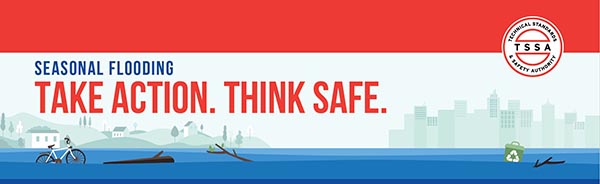
With summer rains increasing the risk of flooding, the Technical Standards and Safety Authority (TSSA) cautions Ontarians to be aware of fuels and elevator related hazards that can occur during flooding conditions. When flooding occurs, key energy infrastructures can become temporarily out of commission, tempting residents to turn to alternatives that may be unsafe.
Did you Know?
- Portable, fuel-fired appliances designed for outdoor use are never safe to use indoors – They can cause carbon monoxide (CO) poisoning, fires and other harmful risks.
- Generators used outside must be situated away from open windows, doors and vents – CO produced by a generator can seep into these openings.
- CO gas can also accumulate in car ports, garages and covered patios – Never use portable, fuel-fired generators, propane BBQs and other fuel-burning outdoor appliances in these areas to prevent CO poisoning.
- Drying a basement with commercial ventilating fans can create a ‘negative pressure’ environment – This can cause CO from appliances in the home to spill back into the home, so ensure there is proper ventilation during the procedure.
- Using an elevator in a flooding building is a safety hazard – Water can accumulate in elevator shafts or adversely affect an elevator’s operation leading to entrapment or injury.
Visit TSSA.org/Seasonal-Flooding-Safety for TSSA’s full seasonal flooding safety guide. Residents and businesses unsure of how flooding conditions may affect the safeness of specific TSSA-regulated devices should contact TSSA.
Online Public Education Campaign Will Run Throughout Fraud Prevention Month
(March 1, 2023) – The Technical Standards and Safety Authority (TSSA) today launches its fourth annual ‘Trunk Slammers’ Awareness and Enforcement Program during Fraud Prevention Month to warn Ontarians about the dangers posed by poor technical workmanship on fuel-burning appliances.
Fuels work can be dangerous—even deadly—if not performed by a professional. Uncertified gas technicians and unregistered contractors, aka ‘trunk slammers’, are known for performing less expensive labour with cheaper, unsafe materials and operating out of the trunks of their cars, which makes it difficult for consumers to locate trunk slammers and hold them accountable.
Since trunk slammers are not certified by or registered with TSSA, their work on furnaces and other fuel-burning equipment is not subject to TSSA audits for compliance with safety requirements. In addition, TSSA cannot validate their knowledge, competency and qualifications. Moreover, there is no assurance they will comply with safety regulations, since they have already disregarded the law by working without proper certification and registration.
“Historical TSSA data indicates that fuel-related risks in private dwellings have been one of the top areas of risk among all of TSSA’s regulated sectors,” said Sam Sadeghi, Director of TSSA’s Fuels Safety Program. “We have identified inadequate installation of fuel-burning appliances and poor maintenance work as the major contributing factors to the risks in people’s homes, which is why it is so important for homeowners to only hire TSSA-authorized individuals to perform fuel-related work.”
Under Ontario law, furnaces and fuel-fired appliances must be maintained by TSSA-registered contractors. Registered contractors are required to hire certified gas technicians who have extensive training aimed at keeping people safe in their homes.
“We would like to remind homeowners that all Ontario contractors authorized by TSSA to perform fuel-related work are listed on the TSSA website,” said Sadeghi.
For more information on TSSA’s ‘Trunk Slammers’ Awareness and Enforcement Program and access to safety resources, visit the following web pages:
- TSSA Fraudulent Fuels Workers Campaign Page
- TSSA Certified Technician Explainer
- TSSA Verifying Fuels Contractors & Inspectors Information Page
- TSSA/HRAI Qualified Contractor Checklist
- TSSA/HRAI Fuels Professional Verification Checklist
- TSSA Registered Contractors Listing
Throughout Fraud Prevention Month, follow TSSA on Facebook, Twitter and LinkedIn to read true accounts of Ontario trunk slammer incidents and get helpful tips homeowners can use to protect themselves.
About TSSA
Throughout Ontario, TSSA administers provincial safety regulations and enhances public safety. TSSA regulates the safety of amusement devices, boilers and pressure vessels, elevating devices, fuels, operating engineers, and ski lifts. Its range of safety services include public education authorization, engineering design review, inspections, investigations, compliance support, enforcement, and prosecution activities. For more information, visit www.tssa.org.
-30-
For more information, please contact:
Alexandra Campbell
Vice President, Communications and Stakeholder Relations
Technical Standards and Safety Authority
Telephone: 416-734-6227
Email: media@tssa.org
With inclement winter weather conditions looming across the province this week, Enbridge Gas and the Technical Standards and Safety Authority (TSSA) strongly advise Ontario homeowners to check their gas meters and the external exhaust outlets for furnaces, fireplaces, water heaters and all fuel-burning devices to ensure no snow or ice builds up. A forecast of rain for some parts of Ontario makes this important safety task time sensitive in areas where snowfall has begun, as rain has the potential to cause further freezing of accumulated precipitation buildup on gas meters and venting pipes.
“Clearing snow and ice away from the gas meter and the external exhaust outlets for your natural gas burning equipment helps ensure that both the meter and your appliances function safely,” said Neil MacNeil, Director Toronto Region Operations, Enbridge Gas. “It also allows us to access the meter in the case of an emergency.”
A gas meter covered in snow or ice can impede its function of controlling the pressure of the gas supplied to a home, which could lead to serious risks. In addition, blocked external exhaust vents can cause the carbon monoxide (CO) emitted by fuel-burning appliances to build up in a home, which is also a significant safety hazard.
“Exhaust vents, in particular, often extend out of the side of a home as low as one foot above ground, so they have the potential to get covered and blocked fairly easily without a homeowner’s knowledge, especially when a homeowner is shoveling snow or using a snowblower or when there is a severe snow fall,” said Sam Sadeghi, Director, Fuels Safety, TSSA. “We have seen CO poisoning incidents from snow-blocked vents in the past, and these incidents can be fatal, so it’s essential that homeowners are vigilant about keeping their exhaust vents clear.”
Upon noticing a gas meter or external appliance vent pipe is covered with snow, please remove the snow carefully with a car brush or broom. Do not scrape the meter or vent pipe with a sharp instrument, as this may cause unintended damage.
Enbridge Gas reminds Ontarians of these additional safety precautions:
- Do not shovel, plow or blow snow up against the meter or vent pipe.
- Be careful not to bump your meter with a snow blower.
- Never kick your gas meter or vent pipes in an attempt to clear ice and snow.
- Remove any icicles from overhead eaves troughs to ensure dripping water does not splash and freeze on the meter or vent pipe.
Visit the Enbridge Gas website for more information on keeping gas meters clear.
“We also encourage homeowners to install and test certified CO alarms, which will warn them of rising CO levels in their homes and give them and their families time to take potentially life-saving action,” said Sadeghi. “It is also important for homeowners to be able to recognize the symptoms of CO poisoning, which can occur once a fuel-burning appliance exhaust vent has been blocked.”
To report a meter icing problem or for any other natural gas emergency, call 1-866-763-5427.
About Enbridge Gas
Enbridge Gas is Canada's largest natural gas storage, transmission and distribution company based in Ontario, with over 170 years of service to customers. The distribution business provides safe, affordable, reliable energy to about 3.8 million customers and is leading the transition to a clean energy future through net-zero emissions targets and investments in innovative low-carbon energy solutions. The storage and transmission business offers a variety of storage and transportation services to customers at the Dawn Hub, the largest integrated underground storage facility in Canada and one of the largest in North America. Enbridge Gas is owned by Enbridge (ENB), a Canadian-based leader in energy transportation and distribution. Learn more at www.enbridgegas.com.
About the Technical Standards and Safety Authority
Throughout Ontario, TSSA enforces provincial safety regulations and enhances public safety. TSSA regulates the safety of amusement devices, boilers and pressure vessels, elevating devices, fuels, operating engineers, and ski lifts. Its range of safety services includes public education, certification, licensing and registration, engineering design review, inspections, investigations, safety management consultation, compliance support, enforcement and prosecution activities. For more information, visit www.tssa.org.
-30-
For more information, please contact:
Andrea Stass
Manager, External Communications and Media Relations
Enbridge Gas
Telephone: 519-365-1010 | Email: enbridgegasmedia@enbridgegas.com
Alexandra Campbell
Vice President, Communications and Stakeholder Relations
Technical Standards and Safety Authority
Telephone: 416-734-6227 | Email: media@tssa.org

(October 7, 2022) – As Ontario homeowners and restaurant operators prepare to extend patio season this autumn, Technical Standards and Safety Authority (TSSA) and safety-minded partners mark Fire Prevention Week (October 9 to15, 2022) by delivering patio heater maintenance guidelines to help keep outdoor gatherers safe from fires and carbon monoxide (CO) poisoning.
Knowing how to properly use patio heaters and open-flame appliances – including fire pits, fireplaces and tabletop units – helps everyone safely enjoy outdoor dining and socializing. With the hope that multiple voices will bring greater impact to this message, TSSA, the Ontario Association of Fire Chiefs (OAFC), Ontario Municipal Fire Prevention Officers Association (OMFPOA), Canadian Propane Association (CPA), and Ontario Restaurant Hotel & Motel Association (ORHMA) offer the following patio heater and open-flame appliance safety tips.
Tips for the Safe Use of Patio Heaters
- Ensure equipment is safety certified – Make sure outdoor heating devices are certified by the CSA, ULC, or another recognized certification body. A list of approved certification marks can be found on the TSSA website.
- Avoid the dangers of fire and CO poisoning – Never use outdoor heating devices indoors or in an enclosed area. If patio heaters are used in a shelter, be conscious of fire hazards and risks of CO build up.
- Recognize the symptoms of CO poisoning – Teach staff and family members to recognize the symptoms of CO poisoning (nausea, dizziness, headache).
- Avoid fire hazards – Be sure to adhere to the manufacturer’s instructions for required clearances from combustible materials such as umbrellas, awnings, walls, tablecloths, paper products, decorations, etc. Don’t forget to locate and identify easily accessible fire extinguishers in the patio area.
- Position with care – Always place patio heaters on a stable surface. Make sure patio heaters do not obstruct doors, fire exits or firefighting equipment and are properly distanced from building air intakes.
- Operate safely – Ensure anyone operating a patio heater understands how to disconnect and install propane cylinders, including how to check for leaks. See the Patio Heater Safety Guidelines for instructions.
- Keep an eye out – Never leave patio heaters unattended and pay particular attention when children or intoxicated adults are in the vicinity.
- Store propane cylinders safely – Never store propane cylinders indoors, in a garage, close to operational heaters, or near smoking areas. Propane cylinders must be stored upright, outdoors, in an area protected against tampering, unauthorized movement, dropping, or impacts that could result in a leak or a fire.
Additional resources on the safe use of outdoor heating devices and propane cylinders, including Patio Heater Safety Guidelines and a Patio Heater Safety Checklist for Restaurant Owners and Operators, are available for download at www.tssa.org.
Quotes
“Owners and operators of outdoor patios and dining areas are responsible for the safe installation, operation, and maintenance of their patio heating units. They must abide by all safety and maintenance instructions outlined in operating manuals and ensure they understand how to safely operate heating units and properly handle propane cylinders. Outdoor heating equipment should not simply be pulled out of storage and turned on each year without being properly inspected and maintained, as per the manufacturer’s instructions.”
-Sam Sadeghi
Director, Fuels Safety, TSSA
“Any type of heating equipment needs regular inspections and maintenance to ensure its proper operation, especially outdoor heating equipment that doesn’t get used for long periods of time during the summer. Always carefully inspect and maintain your equipment per the manufacturer’s instructions to ensure safe operation and get the most enjoyment of your patio and outdoor experiences.”
-Deputy Chief Rob Grimwood
President, OAFC
“Outdoor heating devices are great tools that provide temporary warmth when used according to the manufacturer’s instructions. Improperly used devices can lead to the risk of fire and carbon monoxide poisoning. When using these devices, ensure that they are kept away from combustible materials and used in well ventilated areas.”
-Vince Giovannini
President, OMFPOA
“Propane patio heaters are perfect for warming up chilly nights. Their versatility and portability mean you can heat up just about any space. Taking the time to understand how to use patio heaters and open flame appliances safely will help everyone enjoy the outdoors long into the evening. Follow the TSSA’s safety tips, and for more information on propane, visit the CPA’s website at www.propane.ca.”
-Shannon Watt
President and CEO, CPA
“It is vital for restaurant owners to educate staff on patio heater and propane cylinder safety practices to prevent exposing patrons to serious health and safety risks. By consulting the patio heater safety resources developed by TSSA and safety partners and heeding local fire department guidelines, restaurant owners and staff can serve up safety, in addition to flavour, with every alfresco meal.”
-Tony Elenis
President & CEO, ORHMA
About TSSA
Throughout Ontario, TSSA administers provincial safety regulations and enhances public safety. TSSA regulates the safety of amusement devices, boilers and pressure vessels, elevating devices, fuels, operating engineers, and ski lifts. Its range of safety services include public education authorization, engineering design review, inspections, investigations, compliance support, enforcement, and prosecution activities. For more information, visit www.tssa.org.
About the OAFC
The OAFC represents more than 700 chief fire officers in Ontario, from across 441 municipalities, who are responsible for the management and delivery of fire, rescue, and emergency response to the province’s 14.5 million residents. Its mission is to lead innovation and excellence in public and life safety by inspiring and influencing a safer Ontario. For more information, visit www.oafc.on.ca.
About the OMFPOA
The OMFPOA is an independent, non-profit organization representing approximately 200 fire departments across Ontario. For more information, visit www.omfpoa.com.
About the CPA
The CPA represents over 400 companies in every region of the country and promotes a culture of safe propane handling and use of propane-fueled equipment. For more information, visit www.propane.ca.
About the ORHMA
The ORHMA is the largest provincial hospitality association in Canada. With over 4,000 members, representing more than 11,000 establishments across the province, the ORHMA is dedicated to fostering a positive business climate for Ontario's hospitality industry. For more information, visit www.orhma.com.
-30-
For more information, please contact:
Alexandra Campbell
Vice President, Communications and Stakeholder Relations
Technical Standards and Safety Authority
Telephone: 416-734-6227 | Email: media@tssa.org
Mark Tishman
Executive Director
Ontario Association of Fire Chiefs
Telephone: 905-426-9865 x1228 | Email: Mark.Tishman@oafc.on.ca
Vince Giovannini
President
Ontario Municipal Fire Prevention Officers Association
Telephone: 905- 227-6412 | Email: Vince.Giovannini@thorold.ca
Tammy Hirsch
Senior Director, Communications and Marketing
Canadian Propane Association
Telephone: 587-777-3917 | Email: TammyHirsch@propane.ca
Fatima Finnegan
Director of Corporate Marketing & Business Development
Ontario Restaurant Hotel & Motel Association
Telephone: 905-361-0268 | Email: ffinnegan@orhma.com
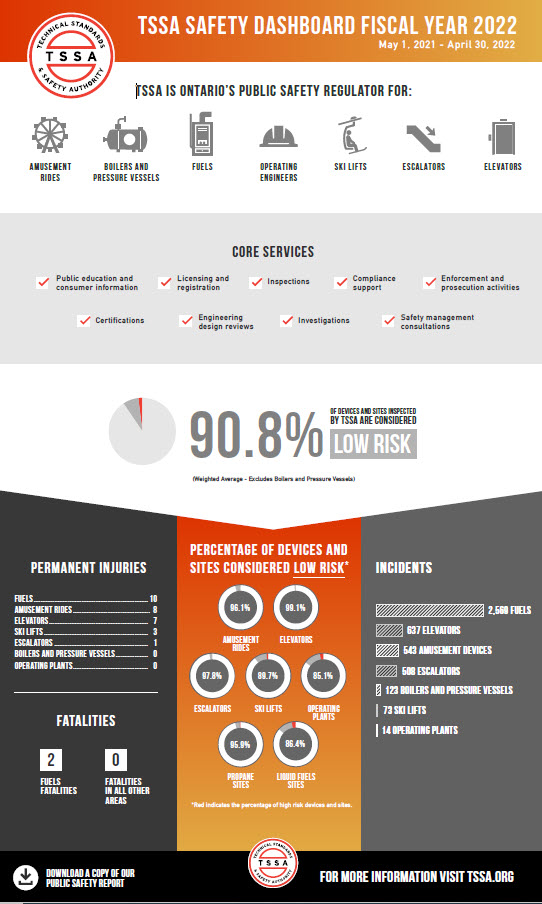
Toronto, ON, September 28, 2022 – Public safety in Ontario continues to improve when compared to 10-year averages across all industries regulated by the Technical Standards and Safety Authority (TSSA), as reported in TSSA’s 2022 Annual Public Safety Report published today. The report was released during TSSA’s Annual Public Meeting along with the organization’s 2022 Annual Report.
“While there have been slight increases in incidents and injuries over the past year, these are still below 10-year averages,” said Viola Dessanti, Director, Strategic Analytics, TSSA. “After a very unusual previous reporting year, when there were so many lockdowns and closures due to the pandemic, we expected to see some increases in incidents as activities began to resume to pre-pandemic levels.”
State of Safety Snapshot
As Ontario’s public safety regulator, TSSA administers technical safety regulations for amusement devices, boilers and pressure vessels, elevating devices, fuels, operating engineers, and ski lifts to enhance public safety in the province. TSSA’s Public Safety Report presents the safety data it collects including the number of incidents and injuries reported, as well as the severity of injuries.
In this reporting period (May 1, 2021, to April 30, 2022, TSSA’s 2022 fiscal year, which will be referred to as 2022 hereinafter), there were five per cent more incidents reported to TSSA compared to the 2021 reporting year. However, the number of incidents that occurred in 2022 is 16 per cent lower than the 10-year average.
Similarly, while injuries more than doubled across all TSSA safety program areas in 2022 compared 2021, the number of injuries was 22 per cent lower versus the 10-year average.
Safety Programs Deliver Promising Results
As an Outcome-Based Regulator, TSSA uses data to understand risk, shape the oversight framework and develop procedures and programs to better target risks and support compliance from regulated parties.
In May 2021, TSSA implemented a lapsed authorizations reinstatement program to ensure that regulated entities renew their authorizations in a timely manner and are not operating without valid licensing. Active authorizations are essential for TSSA to effectively monitor the activities of the businesses, facilities and devices operating in the province and collect data required to validate knowledge, competency and qualifications. Since the launch of the program, 94 per cent of authorizations that had lapsed in fiscal year 2022 were resolved through either renewals or shutdowns.
“Actively following up on authorizations that don’t renew is improving TSSA’s ability to track and follow up with those operating illegally, further protecting the wellbeing of the Ontario public,” said Bonnie Rose, President and CEO, TSSA.
TSSA launched its first major Outcome-Based Regulator initiative, the Compliance Support Program, in 2019. As part of this support-focused program, TSSA uses data to identify regulated stakeholders with high-risk operations and devices and offers them the opportunity to work directly with TSSA to address their specific non-compliances. Since the launch of the program to the end of this reporting period, 160 regulated stakeholders with operations and devices deemed high risk have received free education and engagement to address their specific safety issues. Of those stakeholders, 87 per cent have seen improvements in their risk scores overall.
“The early results of these safety programs are very promising,” said Rose. “We will continue to monitor data and analyze trends to better understand how we can continue to leverage evidence to achieve our goal of a safer Ontario and reduce the potential for public harm.”
For a full picture of the state of public safety in Ontario, access TSSA’s 2022 Public Safety Report at www.tssa.org. The report includes case studies depicting some of the harmful incidents that occurred in Ontario in the past year, as well as actions taken and lessons learned.
About TSSA
Throughout Ontario, the Technical Standards and Safety Authority (TSSA) administers provincial safety regulations and enhances public safety. TSSA regulates the safety of amusement devices, boilers and pressure vessels, elevating devices, fuels, operating engineers, and ski lifts. Its range of safety services include public education authorization, engineering design review, inspections, investigations, compliance support, enforcement, and prosecution activities.
-30-
For more information, please contact:
Alexandra Campbell
Vice President, Communications and Stakeholder Relations
Technical Standards and Safety Authority
Telephone: 416-734-6227
Email: media@tssa.org
Attachments
TORONTO, ON, May 18, 2022 – Hauling out and firing up the grill is a favourite pastime for many and especially when it comes to the marshaling in the May ‘2-4’ weekend. With the unofficial start to the summer season upon us, TSSA wants to equip Ontarians with important information and a few basic tips to practice sensible and safe barbecuing.
- Test for Leaks
- Clean burner ports and tubes; Use a pipe cleaner or wire to ensure burner ports are free of rust, dirt, spider webs or other debris.
- Check the hose leading from the gas tank to the burner and replace it if cracked or damaged.
- Test for leaks with a 50/50 water/dish soap solution on propane cylinder connections and hoses. If bubbles appear, it could mean gas is leaking out so tighten the connection and/or replace the damaged parts and re-test.
- Light it Right
- Before lighting, make sure the BBQ is on level ground, far away from any flammable material, with the lid open.
- Turn the tank’s gas valve on, then the grill controls or heat setting and push the igniter button.
- If there is no igniter button, insert a long match or BBQ lighter through the side burner hole first, then turn on the heat control knob.
- If the burner does not ignite right away, turn the gas off and wait five minutes, keeping the lid open, before repeating the procedure.
- Never lean over the grill when you are lighting it.
- Keep it Outdoors
- Always barbecue outside in a well-ventilated area – BBQs are approved for outdoor use ONLY. They emit carbon monoxide, a poisonous gas that can lead to unconsciousness and even death.
- Propane cylinders may not be used or stored inside any structure.
- Stay Safe
- BBQs are intended to be attended.
- Never leave your cooking/grill unsupervised.
- Keep kids and pets away from the BBQ.
- Keep any flammable items/liquids away from the BBQ. This includes the use of hand sanitizer, whose 60-80% alcohol-based content makes it highly flammable. While hand sanitizer is safe when used correctly it can be a dangerous combination when barbecuing. Keep this in mind, exercise caution and opt for thorough hand washing when getting ready to grill.
- Never throw water on a grease fire.
- BBQs are intended to be attended.
BBQing on Apartment or Condo Balconies: YES or NO?
Ontarians living in apartments and condominiums should be aware of additional safety restrictions and potential hazards related to barbecue use on balconies. Barbecues may be prohibited by the municipality or in the Condominium bylaws of your building or prohibited by the building owner or property manager, so be sure you are aware of any restrictions in place for your building.
- DON’T BBQ on a Balcony IF:
- Prohibited in the bylaws of your municipality and/or condominium.
- Prohibited by the building owner or property manager of a rental property.
- DO BBQ on a Balcony but Only IF:
- Permitted in the bylaws of your municipality and condominium.
- Permitted by the building owner or property manager of a rental property.
- The balcony is open (no enclosures or walls have been erected).
- A propane cylinder is transported in a service elevator; when there are no service elevators, you may use the passenger elevator, but you must be alone.
- The cylinder is kept on the balcony and connected to the BBQ.
- The BBQ is kept clear of combustible material as listed on the BBQ’s rating plate or in the certified instructions.
- The propane cylinder relief valve is at least one (1) metre horizontally from any building opening below it, and three (3) metres from a building air intake.
For additional BBQ safety tips, check out and share our animated safety videos:
TSSA BBQ Safety Tips - Your BBQ Needs Your Full Attention
TSSA BBQ Safety Tips - Make a Clean Start - Test it!
TSSA BBQ SAFETY TIPS - LIGHT IT RIGHT
TSSA BBQ Safety Tips - NEVER BBQ in an Enclosed Space
TSSA BBQ Safety Tips - Taking Your Propane Tank for a Ride
For more information on barbecue safety and other safety topics, visit TSSA’s safety website at www.safetyinfo.ca
About TSSA
Throughout Ontario, the Technical Standards and Safety Authority (TSSA) enforces provincial safety regulations and enhances public safety. TSSA regulates the safety of amusement devices, boilers and pressure vessels, elevating devices, fuels, operating engineers, and ski lifts. Its range of safety services include public education, certification, licensing and registration, engineering design review, inspections, investigations, safety management consultation, compliance support, enforcement and prosecution activities.
-30-
For more information, please contact:
Alexandra Campbell
Vice President, Communications and Stakeholder Relations
Technical Standards and Safety Authority
Telephone: 416-734-6227
Email: media@tssa.org