
TSSA is using the Client Portal to share important, sector‑specific safety information with liquid fuel licence holders who renew their licences online.
Beginning June 1, 2026, operators renewing liquid fuel facility licences through the Client Portal will see a safety message pop‑up. They can choose to read the message immediately or later via email before completing the renewal process.
The Client Portal provides a timely opportunity for TSSA to share critical safety information with liquid fuel facilities to help prevent incidents and support safer operations. We encourage licence holders to read the message and share it with their safety teams.
Operators also have the option to email the safety message to colleagues or individuals responsible for safety, helping to reinforce compliance obligations across their organization.
The safety message will appear only once per account, even if multiple facilities are associated with the same account.
This news was shared with Fuels web subscribers and liquid fuel authorization holders who renew their licences online.
Thank you for attending the webinar on submitting fuel engineering applications through the TSSA Client Portal on April 13, 2026.
We are pleased to share a recording of the webinar for engineering firms and contractors who submit fuel engineering applications on behalf of owners. The webinar showed attendees how to navigate key features of the Client Portal, submit engineering applications, and link third‑party submitter accounts to client accounts.
A recording of the webinar is now available. Click here to view the recording.
This news was shared with Fuels web subscribers and Fuels clients who have submitted engineering applications to TSSA as a third party in the last 12 months.
The Technical Standards and Safety Authority (TSSA) is offering technical training for Ontario professionals working with boilers, pressure vessels, piping, repairs, and alterations.
2026 Training Schedule
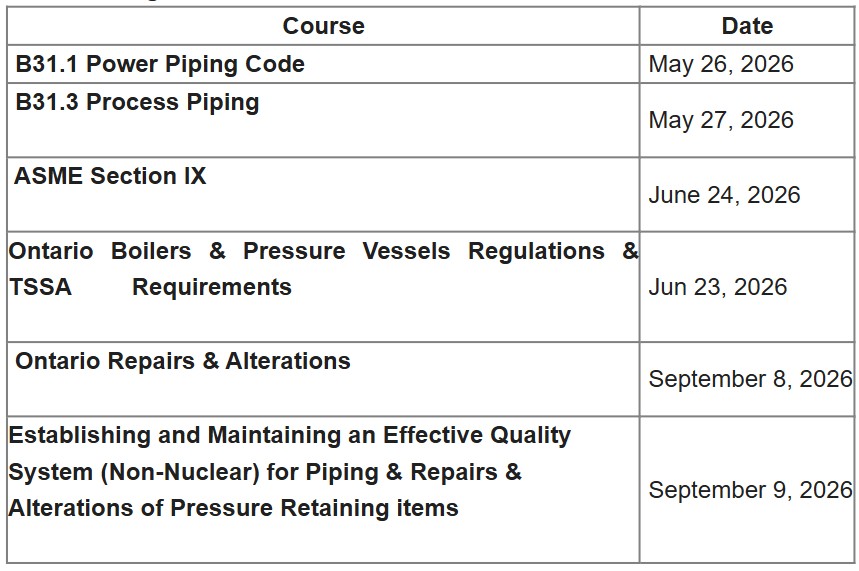
Enrollment is capped at 20 participants per course. Presentation materials in PDF format will be provided to participants before the course dates. Presentation materials mirror the instructor’s presentation and are ideal for note‑taking and reference. Participants are responsible for printing these materials if they wish to do so, or they may bring their computers.
How To Apply
- Review the course descriptions at Certification: Boilers and Pressure Vessels.
- Email Margaret at mwilczewski@tssa.org to confirm the availability of the course you desire prior to booking.
- After availability has been confirmed, complete and submit the application form through the TSSA Client Portal.
For questions related to course selection or registration, please email Margaret at mwilczewski@tssa.org.
This news item was sent to boiler and pressure vessel owners, operators and Certificate of Authorization holders.
The Technical Standards and Safety Authority (TSSA) is offering an online training session for engineering firms and contractors submitting engineering applications on behalf of owners on:
Date: Monday, April 13, 2026
Time: 11 am – 1 pm (EST)
Join the online training:
https://teams.microsoft.com/meet/2701226077314?p=XEtjvB02ncmx1pXJAy
Meeting ID: 270 122 607 731 4
Passcode: nr6dW2yr
This session will provide a walkthrough of the TSSA Client Portal, including:
- How to navigate key features of the Client Portal
- Submitting engineering applications
- Linking third‑party submitter accounts to client accounts
REGISTER NOW TO SAVE YOUR SPOT! Attendance is limited to the first 1,000 attendees.
This new item was sent to Fuels web subscribers and Fuels clients who have submitted engineering applications to TSSA as a third party in the last 12 months.
TSSA is integrating more core services into the Client Portal as part of our ongoing effort to streamline key processes, enhance accessibility, and improve client experience. Starting March 16, 2026, all engineering submissions — including design submissions, variances, and alteration applications — must be submitted through the Client Portal.
TSSA recently held training sessions for Elevating Devices (ED), Amusement Devices (AD) and Ski Lifts to help build familiarity with the new processes. These sessions demonstrated how to send design submissions, dossiers, variances, and alterations through the Client Portal.
If you missed the session or want a refresher, below are links to the recordings of the respective training sessions:
- Elevating Device Submitters: Portal Training, March 6, 2026
- Ski Submitters: Portal Training, March 6, 2026
- Amusement Device Submitters: Portal Training, March 9, 2026
The updated Application forms and specification sheets for the Portal Go-Live are here:
This news was sent to ED and Ski Lift contractors, AD owners and submitters, and web subscribers.
Attention: Operating Engineer Plant Operators
The Technical Standards and Safety Authority (TSSA) is hosting a live webinar to inform attendees about the new Operating Engineer (OE) Compliance Standard which is expected to launch in spring.
Date: Thursday, March 26, 2026
Time: 1 - 2 pm (EST)
Join from the webinar link:
https://tssameet.webex.com/tssameet/j.php?MTID=mf74bddb899775b00ec1dbb941961fd47
Join by webinar number:
Webinar number (access code): 2337 991 2284
Webinar password: wMgtMHk6K23 (96486456 when dialing from a phone or video system)
REGISTER TO SAVE YOUR SPOT NOW! Attendance is limited to the first 1,000 attendees.
The OE Compliance Standard seeks to enhance the safety of plants across Ontario by focusing the efforts of TSSA and regulated parties on addressing high-risk non-compliances promptly. The OE Compliance Standard identifies high-risk non-compliances that pose significant risks to safety. If high-risk non-compliances are found during a periodic inspection, TSSA will issue an order(s) and conduct a follow-up inspection to verify compliance. If compliance is not confirmed, the impacted equipment or plant will be shut down.
Other non-compliances, categorized as safety tasks (low- and medium-risk non-compliances), will be noted on the inspection report. TSSA will not conduct a follow-up inspection if only safety tasks are found during a periodic inspection.
Webinar attendees will have the opportunity to ask questions and learn about:
- How the OE Compliance Standard was developed
- High-risk non-compliances on the OE Compliance Standard
- The difference between high-risk non-compliances on the OE Compliance Standard and other non-compliances
- The process to follow when non-compliances are found during a periodic inspection
Speakers:
- Sandra Cooke, Manager, Compliance, Legal, TSSA
Sandra Cooke is one of the people leading TSSA’s transformation into an Outcome-Based Regulator. Since joining TSSA in 1999, she has held a variety of managerial roles in operations, fuels safety engineering, compliance and business development. She also serves as TSSA’s Ombudsman. Her experience before TSSA includes roles at Ontario Hydro, a gas appliance manufacturer and a certification agency. Sandra is an Ontario Professional Engineer with a master’s degree and a bachelor of applied science in engineering from the University of Toronto. Sandra is a member of the International Ombudsman Association (IOA) and is an IOA-Certified Organizational Ombudsman Practitioner.
- Sue Hadley, Chief Officer, Operating Engineer, TSSA
Sue Hadley is a 1st Class Operating Engineer with 38 years of experience in the power‑generation sector. Her extensive career spans coal, oil, gas, energy‑from‑waste, and biomass facilities, and she has overseen the commissioning of three power plants. From 2012 to 2017, Sue served as an Operating Engineer Inspector with TSSA. She has also taught at BCIT and Lambton College for four years and contributed to organizations such as Achieve Anything and Women in Science and Engineering, supporting the advancement of women in technical fields.
Register for the 24th Annual TSSA Amusement Ride Safety Training Forum. This 3-day forum provides specific training on ride inspection, codes and standards, employee safety and ride manufacturing. Attendees will receive 16 hours of NAARSO continuing education credits.
When: March 24 – 27, 2026
Where: Springhill Suites Vaughan, 612 Applewood Crescent
Agenda: TSSA Amusement Device Training Agenda 2026 - NAARSO
Registration deadline: Friday March 13, 2026
Registration includes:
• March 24th Reception
• March 25h (Breakfast, Lunch, Dinner) (8 hours in class)
• March 26th (Breakfast and Lunch) (4 hours in class, 4 hours practical)
• March 27th (NAARSO level I and II Exams, optional)
SESSIONS: In-Class and Practical Workshops
• Ride Inspection and Audit
• Incident Investigation
• Industry Best Practice
• Manufacturing
• Evacuation
• ESA / TSSA Update
• Operation training
• ASTM 2783
To register or find out more details, complete the form and follow the instructions.
Accredited training providers of OBT 3 and OBT 2 must update training programs and study materials and submit them to TSSA for review
The Technical Standards and Safety Authority (TSSA) has updated the Oil Burner Technician 3 (OBT 3) and OBT 2 curricula to align with the latest CSA B139 Code, which TSSA will adopt in the coming months.
Accredited training providers (ATPs) of the OBT 3 and OBT 2 programs are required to revise their program and materials to align with the updated curricula and submit them to TSSA by February 28, 2026, for approval.
Key changes include the addition of introductory modules from the Gas Technician curriculum and content related to portable generators and biofuel. The revised curriculum and a summary of changes are as follows:
- Oil Burner Technician 2 (OBT2) Curriculum
- Oil Burner Technician 3 (OBT3) Curriculum
- Summary of Changes to Oil Burner Technician 2 (OBT2) Curriculum
- Summary of Changes to Oil Burner Technician 3 (OBT3) Curriculum
TSSA will implement the new exams to align with these changes starting June 1, 2026. Training providers are required to implement the updated curricula to ensure their training programs prepare students for the new exams.
TSSA will send an invitation for a virtual meeting in the coming weeks to address any questions ATPs may have. If there are questions during the interim, please reach out to certificationandexaminations@tssa.org.
This news was shared with OBT 2 & 3 accredited training providers.
Online Training: Reporting Specific Violations in Client Portal
The Technical Standards and Safety Authority (TSSA) is hosting a second online training session to demonstrate to insurer administrative personnel how to utilize the new ‘Violations’ page to enter information about failed inspections and Records of Inspection (ROI) for boilers and pressure vessels (BPVs) in the Client Portal.
We encourage all administrative personnel or users responsible for entering information about failed inspections and ROIs to attend the online training session on:
September 29, 2025 (Monday), 2:00 – 3:00 p.m. EST
2:00 - 2:30 p.m.: Training
2:30 - 2:45 p.m.: Enforcement of Non-Compliance
2:45 - 3:00 p.m.: Q&A
Link to join the online training:
Join the meeting now
Meeting ID: 218 376 758 828 6
Passcode: yS9YE7jL
Microsoft Teams Need help?
The requirement for insurers to report specific BPV violations in the Client Portal took effect on April 14, 2025. High-risk violations must be resolved by BPV owners before a Certificate of Inspection can be issued. Read more
Boilers and Pressure Vessels Safety Program
This news item was sent to BPV insurers and BPV web subscribers.
In Markham District Energy (MDE), power engineering students serve as a secondary line of defence in maintaining safety.
For 15 years, Craig Graham, MDE’s Chief Operating Engineer has been hiring students for four-month work terms. Currently, MDE employs five students per term - 15 students per year. Over the years, Graham has signed off on the Qualifying Experience Time for more than 100 students. This practical operating experience, gained while working in a registered plant, is a prerequisite for applying for higher-level Operating Engineer certifications.
Each student is paired with various operating engineers as they navigate the entire plant, learning from the operating controls, maintenance, and distribution teams. Each student is given three unique questions each week. They discuss their findings with operating engineers who share safety insights on troubleshooting and resolving issues in the plant.
Industry partners are often reluctant to hire Co-op students in their plants, as operating engineers work with high-energy equipment and complex critical systems where errors can have significant consequences.
But MDE takes a different approach by enlisting power engineering students as safety allies. The company attributes its safety track record of one lost-time injury in 25 years, and an operational record of less than three hours of service interruptions in 25 years to collaborating with power engineering students.
“Students don’t just take steam time; they give back by asking staff a lot of questions about processes and procedures, providing good review,” explains Jim Kee, Vice President of Operations. Having experienced engineers share the rationale behind safety protocols keeps their safety knowledge sharp and prevents complacency.
This supportive strategy has enabled MDE with the following advantages:
- Additional assistance with ongoing preventive maintenance, operations, and projects
- Experienced staff provide detailed, plant-specific training, constantly refreshing their knowledge as they mentor students who ask questions
- Operating engineers develop leadership skills through mentoring students
- A ready pool of trained candidates to fill Operating Engineer positions