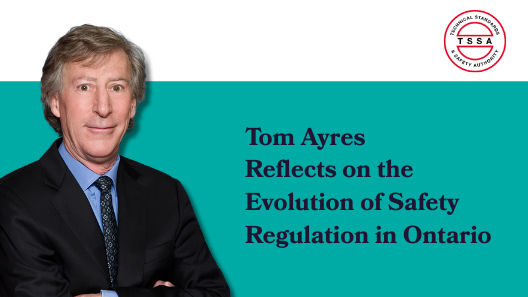
After more than 35 years dedicated to public safety regulation in Ontario, Tom Ayres, TSSA’s Vice President, Policy, Legal and General Counsel, is retiring. He leaves behind a legacy that helped shape the modern regulatory landscape for safety, not only at TSSA but across Canada.
“On behalf of the Government of Ontario, I would like to recognize Tom Ayres for his many years of dedicated public service and leadership in advancing technical safety and consumer protection across the province,” said Stephen Crawford, Ontario’s Minister of Public and Business Service Delivery and Procurement. “His contributions to modernizing Ontario’s safety oversight framework have helped strengthen public safety outcomes for Ontarians and support innovation in regulatory practice.”
Ayres joined the Ministry of the Attorney General in 1988 as a prosecutor assigned to what was then the Technical Standards Division of the Ministry of Consumer and Commercial Relations.
“I actually fell into public safety regulation,” Ayres said. “When I graduated from law school, I articled with the Ministry of the Environment and discovered I really enjoyed regulatory litigation. It felt like a growing area where you could make a meaningful impact.”
At the time, Ontario was experiencing a series of serious safety incidents in regulated sectors, and enforcement was viewed as the primary tool for improving compliance.
“I was hired as a prosecutor because there had been a rash of fatalities, and there was concern that industry had lost its way,” Ayres recalled. “The idea at the time was that prosecution was the way to ensure compliance.”
What began as a legal career rooted in enforcement, however, evolved into something much broader: a decades-long effort to modernize how public safety regulation is approached, implemented and measured.
Building the Foundation
Ayres played a foundational role in the creation of TSSA in 1996 and later helped lead the development of the Technical Standards and Safety Act and its associated regulations, which came into force in 2001.
“Looking back, one of the things I’m most proud of is helping create the legal and regulatory infrastructure that allowed TSSA to operate effectively and efficiently,” Ayres said. “The structure outlined in the Act ended up becoming something other organizations looked to and replicated across the country and in other countries as well.”
But perhaps his most significant contribution was helping transform TSSA from a traditional compliance-focused regulator into one guided by more risk-informed and outcome-based approaches to public safety oversight.
“Much of the progress TSSA has made as a modern, outcome-based regulator is rooted in Tom’s leadership and willingness to challenge traditional thinking,” said Bonnie Rose, President and CEO, TSSA. “His work helped transform how we approach risk, evidence-based decision making and collaboration in support of public safety.”
Rethinking Regulation
In TSSA’s early years, regulatory oversight largely treated all regulated entities the same, regardless of the level of risk they posed. Inspection schedules were standardized, and enforcement approaches were largely reactive.
“Prosecution was considered to be the way to ensure compliance with regulatory requirements,” Ayres recalled. “And so, there was a very aggressive prosecution agenda to try and send a message.”
Over time, however, Ayres began to question whether a purely punitive approach was producing the best public safety outcomes.
“We were prosecuting people left, right and centre and getting significant fines, but it wasn’t necessarily changing behaviour in the way we hoped,” he said. “It became apparent that while some people deliberately break the rules, many others are trying to comply but lack information, resources or support.”
At the same time, Ayres became increasingly focused on developments around regulatory negligence and the need for regulators to demonstrate that their oversight decisions were reasonable, evidence-based and effective.
“That was really the genesis of the risk-informed approach,” he explained.
In 2005, Ayres led the development of TSSA’s Public Safety Risk Management division and championed the organization’s shift toward risk-informed oversight. The transformation involved improving data collection and analysis, implementing risk-based inspection scheduling, and developing more consistent approaches to assessing and prioritizing safety risks.
Building a More Collaborative Approach
The transition toward risk-informed regulation also required a significant cultural shift both within TSSA and among the industries it regulates.
“At one point, regulation was very much a game of cat and mouse. There was this assumption that everyone was trying to cut corners,” Ayres said. “Over time, we realized that most people want to do the right thing. An accident is not good for anybody’s business.”
That realization helped shape a broader regulatory philosophy focused not only on enforcement, but also on industry collaboration, education and compliance support. “There are many tools available to regulators,” Ayres said. “Effective regulation is rarely one-dimensional.”
Continuing the Evolution
Ayres admits that the journey toward modernized regulation was not always straightforward. High-profile events such as the Sunrise Propane explosion in 2008 created renewed pressure for more traditional enforcement approaches and temporarily slowed momentum toward risk-informed oversight.
“There were definitely moments where people questioned whether we were going in the right direction,” Ayres said. “But meaningful change takes time, and you have to stay committed long enough to see whether it’s working.”
In recent years, Ayres says he has been encouraged to see TSSA further embrace outcome-based regulation and modern risk-management approaches.
“We’re at a stage now where we’re increasingly able to demonstrate that these approaches improve safety outcomes for Ontarians while also reducing unnecessary burden on industry,” he says.
A Lasting Legacy
While Ayres is proud of the systems and frameworks developed over his career, he speaks most passionately about the people behind the work.
“What’s always impressed me is how deeply TSSA employees care and are committed to public safety,” he says. “They believe in what they’re doing and try to do the right thing to keep the province safe.”
His advice for future leaders is grounded in the lessons he learned throughout his own career.
“You need to be courageous enough to challenge assumptions and do things that are outside of your comfort zone,” he says. “Most importantly, rely on data and facts and follow the evidence.”